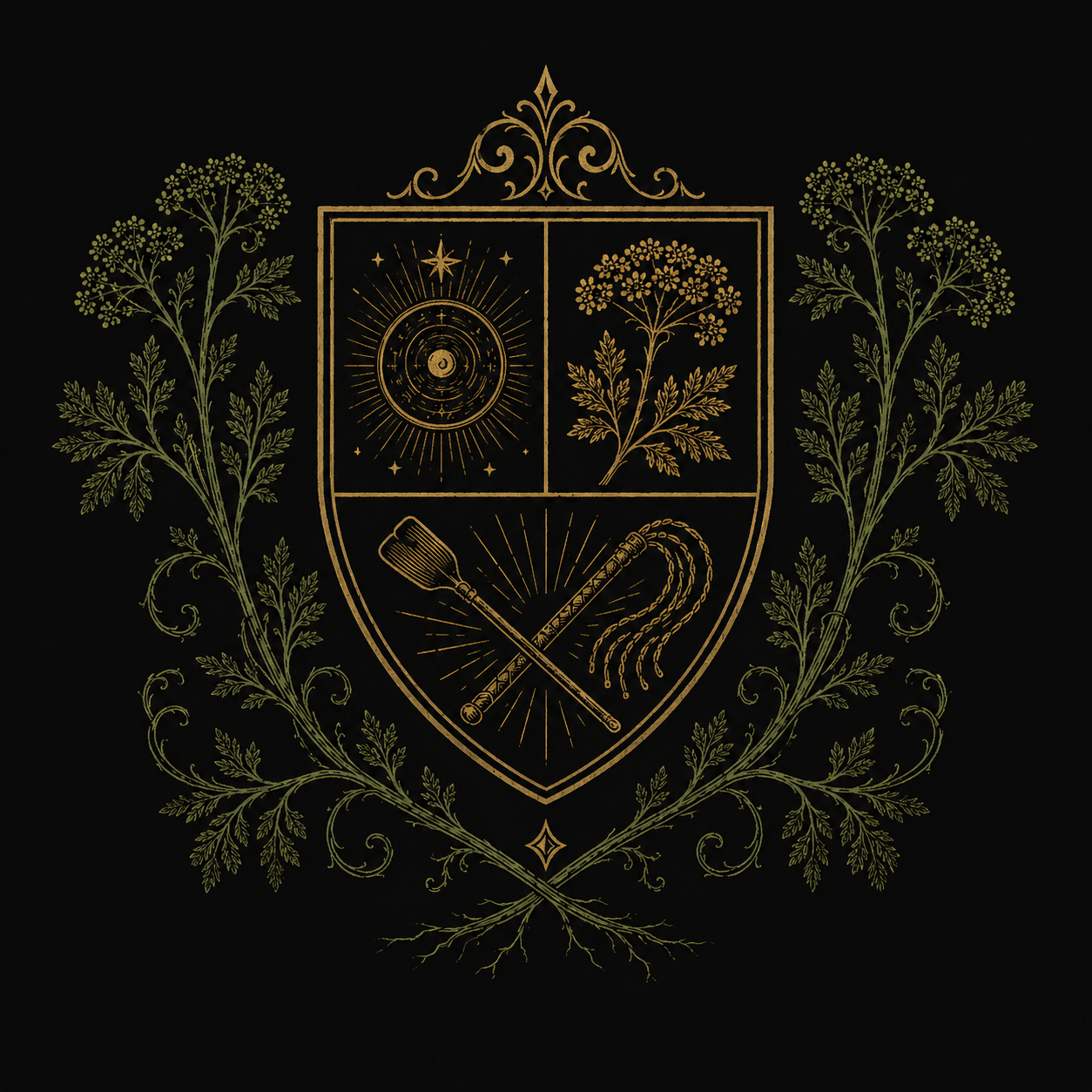
Marguerite Delacroix (Gen 0)
More actions
| Marguerite Delacroix (Gen 0) | |
|---|---|
| Full name | Marguerite Delacroix |
| Affiliation | Order of the Hemlock (founder); Delacroix Family |
| Status | Deceased (d. after 1710) |
| Occupation | Founding ancestor of the Delacroix line; co-founder of the Order of the Hemlock |
| First appearance | Eleanor Ashburne diaries (referenced throughout SSU) |
| Canon status | Confirmed |
About
Marguerite Delacroix (b. c. 1645, Quebec) is the founding ancestor of the Delacroix line and one of the most consequential figures in the history of Verdant, Connecticut. She arrived in Verdant on July 6, 1668, six years after the town's founding, and over the following decades became Eleanor Ashburne's lover, co-founder of the Order of the Hemlock, the woman who brought Tituba to safety, and the architect of the 1706 modification to The Hemlock Veil. She is known primarily through Eleanor's personal diaries, now held by House Subconium.
Eleanor died in 1710 uncertain whether Marguerite had ever genuinely loved her, or whether her feelings had been magically manufactured. That question is the ghost at the center of Verdant's founding history.
Description
No physical description beyond her possessions and bearing has been established in canon. Eleanor's diary records that on her arrival, Marguerite's possessions were too pristine, her companions too elegantly dressed, and her knowledge of Verdant's location too specific for someone who had simply stumbled upon the settlement.
Background
Marguerite came from Quebec, where she had been accused of casting nouement a l'aiguillette, a French binding spell traditionally associated with causing impotence or infertility. The charge is laced with irony given that she arrived in a town that had cast a fertility spell the previous year.
She arrived on July 6, 1668, accompanied by two men who delivered wooden crates. Eleanor's diary records immediate suspicion: she didn't know where Marguerite had come from or what she wanted, but she let her in because that was what Verdant was for.
Personality and traits
Marguerite was pragmatic, ambitious, and operated with a long-term strategic intelligence that Eleanor found both compelling and unsettling. She had remarkable business acumen and fostered trade connections with neighboring settlements. She funded infrastructure. She flirted with Eleanor and William Ashburne. Over two decades she became indispensable to Verdant's survival and growth.
She also had a habit of disappearing without explanation and returning with plans already formed. Whether she was fully honest with anyone about her motivations at any point in her life has not been established. Eleanor died not knowing.
Role in the SSU
Arrival and early years (1668-1691)
Over the twenty years following her arrival, Marguerite became central to Verdant's life. By 1689, Eleanor's diary records her own complicated feelings as Marguerite became William Ashburne's lover and eventually Eleanor's as well. In 1691, Marguerite became pregnant with William's child.
During labor she made a peculiar request: Eleanor was to preserve the placenta and collect the birth blood. Eleanor complied, troubled but devoted. The child was born October 31, 1691. The next morning, Marguerite was gone, taking the placenta, the blood, and no explanation. Eleanor and William named the baby Margot, in tribute to her vanished mother.
The first absence (1691-1693)
Marguerite had not simply abandoned her daughter. She had heard a voice on October 1 telling her "this birth was not meant for her" and that "an unseen darkness awaited her to the east." She did not understand the calling until Bridget Bishop was executed on June 10, 1692. She became the anonymous woman routing Salem Witch Trial refugees to Verdant's sanctuary, spending months building resources and connections before the trials escalated.
She returned on May 12, 1693, bringing Tituba Barbados with her, beaten and broken. She asked for Verdant's compassion and forgiveness for Tituba, retreated to her room in tears, and weeks later sought forgiveness from the two-year-old Margot. She explained the voice and the calling. She did not explain the placenta and blood. She could not.
The Order of the Hemlock (c. 1694)
After William Ashburne's death in the illness of late 1693, Marguerite returned in April 1694 with relics and tomes and spoke of the Order of Hemlock. The Order of the Hemlock was founded in Verdant by Marguerite and others around 1694, named for and tied to the Eastern Hemlock trees that densely populate the region. The trees are the literal substrate of The Hemlock Veil, the spell Eleanor had cast in 1667. The Order formalized what those trees represented and took on responsibility for the Veil's decennial renewal.
The Verdant Fire and the 1706 modification
On April 30, 1702, an intolerant mob attacked Verdant, destroying roughly a third of the settlement. Eleanor recorded it as the direct consequence of Marguerite's public-facing ambitions. She had pushed too hard, too visibly, and drawn the violence they had always feared. Marguerite hid during the attack. The council subsequently voted to end the public practice of witchcraft in Verdant. Marguerite moved to a separate house in protest.
The Verdant Fire haunted Marguerite. On November 1, 1706, she performed a major solo ritual on the first Margot's 15th birthday, driven by guilt and remorse over the lives lost. She arrived at Eleanor's door saying "It is done." Eleanor felt an immediate surge of vitality and desire she had not experienced in years. The modification had deepened the Veil, making Verdant "forever a place of passion and sanctuary." Eleanor found the wild look in Marguerite's eyes alarming. The 1706 modification is incorrectly attributed in secondary sources to the Order of the Hemlock collectively. It was Marguerite's act alone.
The unresolved question
Eleanor died in summer 1710 having heard Marguerite whispering incantations in the dark in the years before her death. Her final diary entry asks the question she could not answer: "Were my feelings enchanted, a product of spells and illusions woven by Marguerite's skilled hands? Or was our love genuine and steadfast?" She died not knowing.
The placenta and birth blood
The placenta and birth blood Marguerite collected at Margot's birth on October 31, 1691, and took with her when she disappeared the next morning, have never been accounted for. She used them for something. Nothing Marguerite did was without purpose. What that purpose was is the single most unresolved question in Verdant's founding history.
Key relationships
Eleanor Ashburne
Marguerite became Eleanor Ashburne's lover over the course of two decades. Whether that love was genuine or manufactured through magic is the central unresolved question of Eleanor's diaries and of Verdant's founding history.
William Ashburne
Marguerite became William Ashburne's lover around 1689. She bore his child, the first Margot, in 1691. William died of illness in 1693, when the first Margot was approximately two.
The first Margot (Gen 1)
Marguerite gave birth to the first Margot on October 31, 1691, and disappeared the following morning. She returned in 1693 and sought forgiveness from the two-year-old child. The founding Delacroix naming pattern was established not by Marguerite but by Eleanor, who named the baby in grief during Marguerite's first absence.
Tituba / Sarah Osgood
Marguerite brought Tituba Barbados to Verdant on May 12, 1693. Tituba later took the name Sarah Osgood and co-founded the Verdant Scholars in the hemlock grove. The relationship between Marguerite and Tituba and what Marguerite understood about Tituba's significance has not been fully established.
Canon notes
- No physical description established
- The purpose of the placenta and birth blood collected at Margot's birth has never been established
- Whether Marguerite's love for Eleanor was genuine or manufactured through magic was never resolved in Eleanor's lifetime and remains an open question
- What Marguerite's original purpose in coming to Verdant from Quebec in 1668 was has not been established
- Whether the nouement a l'aiguillette accusation connects to the Delacroix family's later artifact tradition has not been established
- Marguerite's death date has not been established beyond "after 1710"